Understanding Business Firms: Framework, Benefits, and Challenges
A company firm is a lawful entity different from its proprietors, giving a structure for running a company while providing obligation defense and potential tax advantages. This entity type, whether a little family-owned company or an international empire, plays an important role in the global economic climate. about us company examples are structured to have shareholders who spend resources, a board of supervisors who supervise corporate policies, and policemans that manage day-to-day operations. This separation of ownership and control allows firms to attract investments, as investors can conveniently move their shares without affecting the firm's operation. The company structure likewise gives limited obligation to its investors, indicating that they are usually not directly in charge of the firm's debts and obligations.
However, companies encounter their collection of difficulties. Regulative compliance can be troublesome, including considerable record-keeping, complicated tax obligation filings, and adherence to both local and global laws, depending on the scale of procedures. Furthermore, the benefit of restricted responsibility can occasionally result in a lack of liability, with the prospective to protect dishonest actions by those in cost. Despite these challenges, the corporate framework continues to be a popular selection for businesses seeking to scale their procedures and accessibility funding markets. Recognizing the intricacies of exactly how corporations are developed and run is important for any person wanting to dive right into the company world, whether as a policy-maker, investor, or entrepreneur.
Comprehending Organization Companies
An organization firm, commonly referred to as a merely 'company', is a legal entity unique from its proprietors, offering a crucial benefit in terms of restricting the proprietors' personal obligation for service financial obligations and activities. This entity can be structured in different kinds, consisting of private and public corporations, and its life is perpetual, going beyond the modifications in possession or management unless it opts to liquify. Corporations are licensed to provide supply, which is a means of raising funding by marketing ownership shares in the firm. This capability not only aids in gathering a substantial amount of resources for growth and operational activities however additionally in dispersing the risk among a broader team of stakeholders. Furthermore, the capability to market stock makes it possible for companies to attract and preserve top talent by providing stock choices or various other equity-based rewards. The governance of a company is overseen by a board of supervisors, chosen by the shareholders, that makes significant choices including the consultation of executive officers that take care of the daily procedures. This splitting up of ownership and monitoring allows the corporation to be skillfully managed, while owners or shareholders can concentrate on investment returns without taking part in daily operational responsibilities. Taking into consideration global organization techniques, corporations can run across borders a lot more effectively than other business forms, as they are acknowledged as separate legal entities nearly universally, assisting in much easier conformity with global legislations and transactions. The adaptable and robust structure of firms hence plays a pivotal duty in cultivating growth, technology, and scalability in modern economic climates.
Comprehending the Structure and Administration of Organization Corporations
Organization firms are intricate entities characterized by their lawful framework, hierarchical administration, and unique operational methods which fundamentally identify them from various other company types. At the core of a company's identity is its lawful recognition as a different entity from its owners, which manages it one-of-a-kind rights, obligations, and obligations. This separation means that the individual properties of shareholders are safeguarded from company financial obligations and liabilities, an appealing function that encourages investment. Corporations are normally handled by a board of directors chosen by the investors. This board carries the duty of setting broad policies and goals, overseeing major decisions, and selecting executive officers that manage the daily procedures of the firm. The executives, such as the chief executive officer, CFO, and COO, are tasked with executing the board's policies, steering the firm in the direction of its calculated goals, and making sure functional performance. Firms must adhere to rigorous coverage demands, making sure openness and responsibility. These demands are not just restricted to financial disclosures but additionally include aspects of company administration, ecological compliance, and social obligation. This level of analysis is meant to safeguard the passions of stakeholders, including capitalists, employees, and the community at large. Additionally, the ability to raise capital via the sale of stock is a considerable benefit of firms, allowing them to fund development, buy research study and advancement, and improve facilities. This access to substantial capital markets can assist in substantial development and development, positioning firms at the center of worldwide financial activity. However, the benefits of this framework featured the complexity of policy and the need for an organized management framework to handle such a large and usually geographically spread operation successfully.
Key Components of Service Companies
Company corporations are intricate entities that are structured to conduct industrial activities in an arranged fashion. At its core, an organization company is a lawful entity different from its owners, providing them with limited obligation and an organized structure to pursue organization goals. This legal splitting up is critical as it shields the individual properties of investors from the financial debts and liabilities of the firm. Companies are commonly handled by a board of supervisors, chosen by the investors, that make significant plan and critical decisions while overseeing the total events of the business. The day-to-day operations, however, are handled by supervisors and policemans that deal with the implementation of plans and the implementation of strategic initiatives. One more crucial element of company companies is their ability to increase resources. Unlike sole proprietorships or collaborations, firms have the advantage of releasing stock to a vast range of investors, which can be a critical component for development and development tasks. This capacity to market shares and thus distribute ownership throughout a wide spectrum of capitalists not only dilutes private danger yet also improves the company's capacity to utilize additional resources. Furthermore, firms gain from perpetual existence, suggesting the entity continues to exist past the life expectancy of its initial shareholders. This attribute is especially beneficial as it permits continuous business operations no matter of modifications in ownership, which can be necessary for long-lasting job preparation and sustainability. 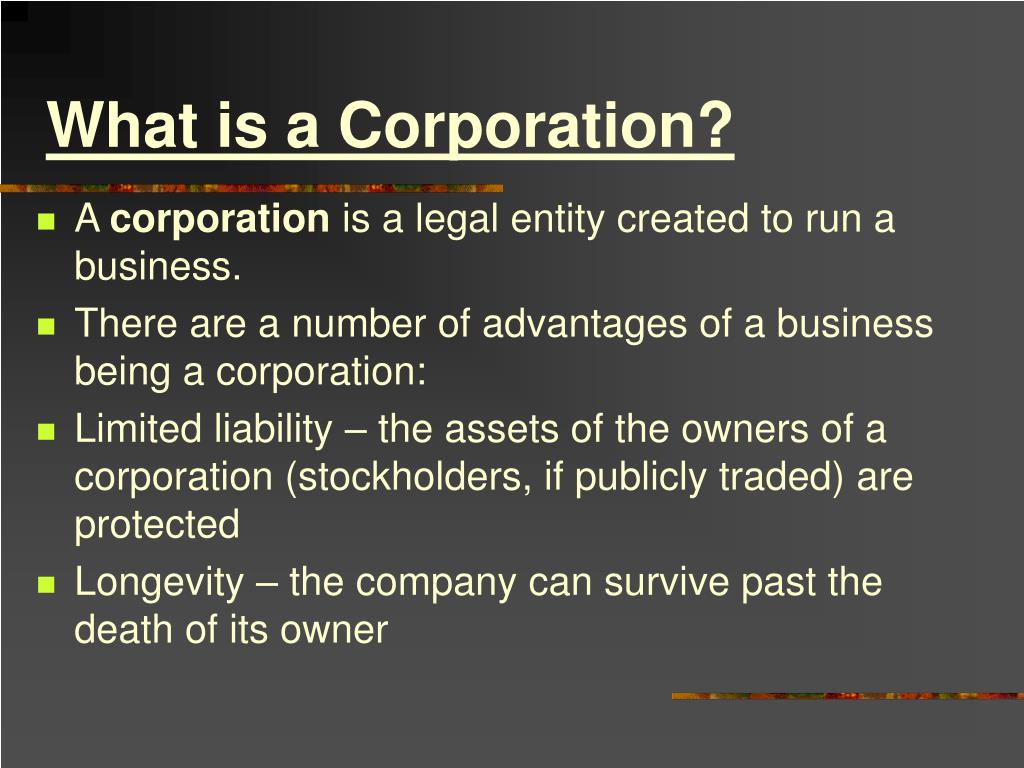 Taxes is another considerable element where companies differ significantly from other service structures. In many territories, firms are strained on their earnings, and shareholders are additionally taxed on returns, a principle understood as double tax. Nevertheless, this can be alleviated by different business structures, such as S corporations in the United States, which are tired more like collaborations to avoid this double burden. The selection of company framework, including considerations for taxes, legal needs, and financial ramifications, is therefore a vital decision that can drastically affect the practicality and success of the entity. Generally, the framework and function of business companies are developed to sustain business tasks on a range that other service types could not have the ability to maintain. With their ability to mobilize significant resources, manage danger through limited responsibility, and proceed operations indefinitely, firms play a critical duty in the worldwide economy, driving development, work, and economic development.
Recognizing the Function of Shareholders in Organization Companies
In the landscape of business companies, shareholders play a critical function, both in terms of administration and economic wellness. Mainly, investors are the proprietors of a company and their investment is what fuels the company's capacity to operate and expand. Each investor has a section of the firm in the form of shares, which represent a fraction of the company's equity. This ownership provides the investors certain civil liberties consisting of the right to elect on major company choices, such as the election of the board of mergers, procurements and directors, and various other substantial company policies. The board of supervisors, elected by the shareholders, holds the responsibility of managing the company's management and ensuring it aligns with the finest rate of interests of the shareholders. In return for their financial investment, shareholders expect to receive rewards, a share of the firm's revenues, which are paid out in accordance to the quantity of stock they own. The advantages are not without threats; the worth of shares can vary widely depending on the business's efficiency and market conditions, potentially impacting the overall financial investment. Moreover, in the occasion of liquidation, shareholders are paid just besides financial obligations and responsibilities of the corporation have been cleared up, which could mean shedding all their financial investment if points go awry. Comprehending these dynamics is essential for any individual entailed in or with company firms, as these aspects seriously affect company techniques and financial outcomes.